I just returned from the states a few days ago and was scolded for not writing enough in this blog. I have to be honest I didn't think anyone was reading it and so I opted for neglect. But I am newly encouraged and always cognizant that memories and experiences (and stories most of all) will be lost if I don't write them here.
Also since I returned from the state I got a new perspective on some of the goings-on around town. Like Jeffery Sachs and the Millennium Village Project (MVP). Sachs has hit on the socially cool and conscious crowds like the iPhone hit hipsters and so I have to weigh in. One of Sachs' "Millennium Development Villages" is actually a regional collective of villages whose eastern-most reaches are a mere 15k from where I live in Louga. I won't go into the details of the project here, mainly since the undertaking is so broad and nebulous that i could not explain in concisely. But you can check it out on the site, or read about it, well anywhere lately. Or you can check out anybody in Hollywood that happens to be wearing the t-shirt.
A few volunteer friends and I had the opportunity to visit several of the work sites a few weeks ago, graciously guided by one of the project's technical agents. We visited massive agricultural plots built into the rich dunes of the Niayes region, an area that cultivates the large majority of Senegal's produce. Our agent guide explained that onion production in the area has doubled since the outset of the project just 1 year ago, allowing sales of the onions to extend to the distant market of Diaobé in the south.
As we toured far-flung villages we occasionally came across farmers making their way to an MVP meeting to receive new instruction on rainy season gardening and additional seed. The farmers knew our guide and driver and vice versa. Often the men in their long robes and conical, broad-rimmed hats climbed into the truck bed for a ride to the next village. Twice we spotted camels grazing on spiny acacia and one we found ourselves mired in sand. One particularly harrowing path bore our hurtling SUV through vegetable fields bordered with cactus. The path was wide enough only for a donkey cart and it would have been an uncomfortable ride even for the donkey. When we piled out of the car shaken and breathless, the car was striped with hairline scratches, smudges of pink from the cactus fruits and the occasional branch or thorn. I had to wonder if much of the MVP's money is lost to car repairs and paint jobs.
The school at which we had arrived had already closed for lunch but before we left the car we already saw school teachers, children and the village chief racing up the hill towards us. Everyone knew it was a visit from MVP and everyone wanted to be present. The group showed us their new classrooms and toilets, courtesy of MVP, which replaces the straw and tin shelters which previously housed the single classroom on the hill. The school's two teachers were present, neither of them older than myself, and we witnessed their precise French lessons written on the board. The second teacher did evening adult literacy education for local women in Pulaar, their native tongue. The group present was extremely proud of the progress they had made, but at the same time the teachers and village chief knew they needed to seize the opportunity to expound on what was still lacking while they had us in front of them. the resulting discussion was more than a little awkward for myself and the other volunteers who had nothing to offer and no influence or background knowledge in the MVP's work, but it was nonetheless an opportunity to learn how well the MVP really works. The water supply for the school was no good, they said. It came out of the pipes bright orange and could not be used to drink or to irrigate crops. Then came out other requests-- the students had no school books and the schools benches had not yet arrived. This all hints at the possibility of a litany of holes in the MVP approach, which attempts to address every physical need with apparently less attention to sustainability, education and capacity building. At the same time, I have learned to become very skeptical and critical of what people ask for before I try to provide it.
I haven't entirely decided whether the MVP will be effective or not (although i seriously doubt it can achieve all that it portends to in the few short years of its duration). But I've broken it down into some pros and cons.
Pros:
1) MVP uses quasi-local professionals to administer the projects. These individuals understand the local language and culture better than any American could.
2) MVP works from the ground up. Local and regional governments are bogged down in bureaucracy.
3) MVP focuses on building financial stability for the region first. By showing local populations that there is money to be earned, they are bound to have good participation.
Cons:
1) The project lasts only a few years, after which its investments will fizzle, or not. It is not clear if an emphasis has been made on local sustainability.
2) MVP appears to do a lot of giving, sometimes without the necessary trainings and public education that is needed. Sometimes this glut of offerings creates dependency and expectations that help will always fall from the sky.
3) In the rush to build and produce it seems that some basic needs have been overlooked, like potable water in the village we visited.
I'd love to hear your thoughts and experiences with the MVP (especially those of you who are on the ground working with the projects). I think I would still put my money with MVP, they have been generous and ambitious about fixing problems. But I have my reservations.
All my best!
Thursday, July 05, 2007


Saturday, June 09, 2007
Wolof Words
I am always amazed by the Wolof language. It is simple. There are few words that have more than 2 or perhaps 3 syllables. It is direct. The elaborate twisting of sentences we have in French or English doesn't exist. It is vibrant. and loud. Most statements can easily be confused with shouts, expletives or arguments. It is funny. A good looking girl is a "diskette,"
an attractive boyfriend is an "expensive fish." And most of all it is absolutely unique to life in Senegal. There is a specific word for "to be able to carry something alone all of the way". There is a word that means "to prepare the spices for stuffing the fish". There is equally a word for carrying something on your head. I recently learned that there is a Wolof word for being pickpocketed. From a sort of nerdy, linguistic point of view, this is interesting. Most new inventions don't have Wolof names, only imports from the French language. But "pickpocketing" has a Wolof name? Did it exist way back when? Or is it just one of those rare words that was specially assigned its own word? And why "pickpocketing"? Why not "email" like the French "courriel". I guess some legacies just don't last
an attractive boyfriend is an "expensive fish." And most of all it is absolutely unique to life in Senegal. There is a specific word for "to be able to carry something alone all of the way". There is a word that means "to prepare the spices for stuffing the fish". There is equally a word for carrying something on your head. I recently learned that there is a Wolof word for being pickpocketed. From a sort of nerdy, linguistic point of view, this is interesting. Most new inventions don't have Wolof names, only imports from the French language. But "pickpocketing" has a Wolof name? Did it exist way back when? Or is it just one of those rare words that was specially assigned its own word? And why "pickpocketing"? Why not "email" like the French "courriel". I guess some legacies just don't last
Wednesday, May 09, 2007
Lions!
First of all, it is really unbelievably hot here-- so hot that after barely 1o days of working I am exhausted and so dehydrated from walking in the sun that my hands shake. But I'm not complaining :) It's time for a vacation!
Second, a funny story to share... just because I have no shame. I was supposed to meet a client yesterday at 3:30 to go visit a bank together before I started a training at 5 pm. He was early, so came by my room to see where I was. I told him I would be there in a minute and he went to sit with some family members. So I rushed to get dressed and started to gather my stuff for the training. I brought my bag and kit out and set them down next to my 20-year-old host brother, who is really shy and who I have just started to be close to. We were chatting a bit when I realized that I had forgotten something in my room. I turned to go back into the room, turning my back to him and at the same time reached back to check the zipper on my dress-- which I naturally had forgotten to zip. I very calmly zipped it and continued walking to my room.... but ever since then I have not seen my brother once! I am pretty sure he was mortified to see me so exposed in a country where I don't even show my knees!...
In other, more PC news... I visited a "simb" the other day, also known as "faux lions" or fake lions. It's a sort of a neighborhood fair/block party to raise money for the local community associations. Essentially big scary men dress up in costume and dance and act and also "trap" people from outside who do not pay tickets to come inside, then they bring these poor souls into the middle of the whole crowd and make them do silly tricks. Of course I got singled out 4 separate times since I was the only white person for miles around, but I had a great time with it, and my sisters really got a kick out of it too. Most impressive was the man with a body-builder physique dressed in drag and the man on stilts who did crazy Senegalese dance in the deep sand. Truly impressive. So I hope you enjoy the photos :)


Second, a funny story to share... just because I have no shame. I was supposed to meet a client yesterday at 3:30 to go visit a bank together before I started a training at 5 pm. He was early, so came by my room to see where I was. I told him I would be there in a minute and he went to sit with some family members. So I rushed to get dressed and started to gather my stuff for the training. I brought my bag and kit out and set them down next to my 20-year-old host brother, who is really shy and who I have just started to be close to. We were chatting a bit when I realized that I had forgotten something in my room. I turned to go back into the room, turning my back to him and at the same time reached back to check the zipper on my dress-- which I naturally had forgotten to zip. I very calmly zipped it and continued walking to my room.... but ever since then I have not seen my brother once! I am pretty sure he was mortified to see me so exposed in a country where I don't even show my knees!...
In other, more PC news... I visited a "simb" the other day, also known as "faux lions" or fake lions. It's a sort of a neighborhood fair/block party to raise money for the local community associations. Essentially big scary men dress up in costume and dance and act and also "trap" people from outside who do not pay tickets to come inside, then they bring these poor souls into the middle of the whole crowd and make them do silly tricks. Of course I got singled out 4 separate times since I was the only white person for miles around, but I had a great time with it, and my sisters really got a kick out of it too. Most impressive was the man with a body-builder physique dressed in drag and the man on stilts who did crazy Senegalese dance in the deep sand. Truly impressive. So I hope you enjoy the photos :)


Tuesday, March 27, 2007
Excellent MicroCredit Article
This article demystifies micro-credit lending for anyone interested. Accurate, concise and entertaining, it provides real feedback on the variety of lending sites out there. Read it!
A Good Run for your Money: Which microlender makes best use of your $20?
A Good Run for your Money: Which microlender makes best use of your $20?
Gotta love days like these


There have been some excellent happenings around town...
there is a new baby in the family who is totally sweet. just 6 or 7 little pounds and only opens her eyes a few times a day, but I love her all the same.
there is going to be (inch'allah) a new volunteer in Louga! I can't tell you how excited I am about this (my very own little baby to welcome into the world!) Not really, but with both of my neighbors and practically half of the volunteers I am in touch with checking out in the next two months, I think I will need the new company. And plus, this volunteer will work in Urban Agriculture, which I think is sorely needed in this town. You can see some photos of a training we recently did with a women's group on gardening in alternative containers. A visiting volunteer led the training and I supplemented with a little business knowledge. I've been following up with these women and they are awesome, super self-motivated and they don't get discouraged when the lizards eat their plants, they just fix the problem (alxamdoullilahi)
tomorrow is my first real session with the girls club-- a group of 20 or so high performing girls from a local middle school, led by last year's scholarship winner ($50 to buy school supplies). It will be a little tricky to get our program to fit into the girls' schedules, especially since the school will be striking, taking a 15-day vacation for Easter (you'd never know they were all Muslim) and ending in late May but we will make it happen. On the plan for this year are learning to use the Internet, learning to do dynamic presentations and improved research (on figures in African American history), a meeting with professional women and career discussion , an exchange of American and Senegalese cuisine and maybe even a visit to the American Embassy in Dakar where there is a great library for the students to use and maybe even a chance to meet with one of the women who works there. Budget poses a little bit of a problem (as it always does) but the school will help a little bit and we will find some money somewhere else I hope!
We are still cooking on occasion (made okonomiyaki the other day in my bathroom/kitchen/storage room) which turned out to be delicious and in my absolute boredom and (let's be honest) curiosity, I also pickled several pounds of beets. Hey, whatever keeps you sane. Cheers!
Monday, February 26, 2007
Media Frenzy
here are two links from my mom and my brother with good stuff on Senegal
First the elections-- which came and went with really no serious event other than some pep-rally like cheering sections in the streets. The NYTimes covered it here
I really like the article for some its summary of what Ablaye Wade means for the country-- he has a long political past here and I am still trying to figure out all of it.
Second is a film made in the south of the country. I love the images in it. The people are very real Senegalese (the film-maker used an all-local dance and theater troupe) and the scenery is of course, true to life. Maybe the story is a little trite (clearly made by a european white guy) but still worth a look.
Binta and the Great Idea
First the elections-- which came and went with really no serious event other than some pep-rally like cheering sections in the streets. The NYTimes covered it here
Senegalese Vote Hinges on Views of Economic Growth
I really like the article for some its summary of what Ablaye Wade means for the country-- he has a long political past here and I am still trying to figure out all of it.
Second is a film made in the south of the country. I love the images in it. The people are very real Senegalese (the film-maker used an all-local dance and theater troupe) and the scenery is of course, true to life. Maybe the story is a little trite (clearly made by a european white guy) but still worth a look.
Binta and the Great Idea
Saturday, February 24, 2007
Tomorrow is Election Day
That's the big news (that and my Senegalese god-daughter will be named tomorrow). There is some interesting info on the elections here: BBC provides short synopses for 10 of the 15 Presidential candidates.
Here is a blatant personal opinion regarding these elections and all the hype coming from within senegal and from the US. Whether or not these elections are fair and transparent, I really don't think that there is much to worry about. Everything we hear is about threat of violence or corruption, etc. In reality, I think the transition (or retention) of power will pass just as peacefully as anything else here. It certainly will not surpass your average school strike or rowdy soccer game. And as far as corruption? the only thing rigging votes are lack of infrastructure and a new and completely untested voting system. So why did the US have to issue a press release asking pretty please Senegal will you have free and open elections? Yes. they are trying, it is not that simple.
Here is a blatant personal opinion regarding these elections and all the hype coming from within senegal and from the US. Whether or not these elections are fair and transparent, I really don't think that there is much to worry about. Everything we hear is about threat of violence or corruption, etc. In reality, I think the transition (or retention) of power will pass just as peacefully as anything else here. It certainly will not surpass your average school strike or rowdy soccer game. And as far as corruption? the only thing rigging votes are lack of infrastructure and a new and completely untested voting system. So why did the US have to issue a press release asking pretty please Senegal will you have free and open elections? Yes. they are trying, it is not that simple.
Sunday, January 28, 2007
Cooking class
It's been a long time coming, and the other day when yet another class was canceled due to no-shows I took the opportunity to be home early and learn how to cook a Senegalese dish start to finish. I'm so proud of what I learned that I want to share a little bit about it.
The dish is called "domoda," a classic Senegambian fish and rice combo with a thick tomato-y sauce and all the regular veggies, cabbage, manioc, carrots, turnips, squash, etc. the details of all the prep aren't terribly exciting. But then there came the moment that I was asked to squish the tomatoes one by one with my bare hands. How satisfying. And it got better. We started frying the fish up a little bit and suddenly it all made sense. I had never been able to figure out the tiny, slightly irregular marble-type things in the food. But here they were, fried fish eyeballs. Who knew they could balloon like that?
once we finished prep for lunch it was time to get started on dinner. In Senegalese cuisine lunch is the main meal. It requires a long time to cook and is usually quite a bit more expensive (and tasty) than dinner. For dinner, we tend to have a little bit of rice with bits of dried fish or kinds of meat 'extras', stomach, organs and the like. The dried fish, known as "ketcha" that ends up in these dishes is very inexpensive because it is actually fish that has started to spoil and then was dried and salted. I've known this for a long time and I guess I learned to live with it (and the strong taste that comes with it). Habit can change I suppose. Well for dinner I got to prepare the ketcha. I was handed a paper bag with three dried fish in it and told to pick out the bones. I started to work using my best knowledge of the anatomy of a fish and was bent intently over my task when I realized that in the effort to pick out the tiny bones I had completely ignored the fact that I was actually digging right into maggots. I was more than a little shocked, but I couldn't drop the fish and make a scene... it is, after all, the same dish we eat almost every day. So I leaned casually over to my sister and asked her about it. She told me I was doing just fine... when we washed the fish later all the maggots would come off.
Bon appetit!
The dish is called "domoda," a classic Senegambian fish and rice combo with a thick tomato-y sauce and all the regular veggies, cabbage, manioc, carrots, turnips, squash, etc. the details of all the prep aren't terribly exciting. But then there came the moment that I was asked to squish the tomatoes one by one with my bare hands. How satisfying. And it got better. We started frying the fish up a little bit and suddenly it all made sense. I had never been able to figure out the tiny, slightly irregular marble-type things in the food. But here they were, fried fish eyeballs. Who knew they could balloon like that?
once we finished prep for lunch it was time to get started on dinner. In Senegalese cuisine lunch is the main meal. It requires a long time to cook and is usually quite a bit more expensive (and tasty) than dinner. For dinner, we tend to have a little bit of rice with bits of dried fish or kinds of meat 'extras', stomach, organs and the like. The dried fish, known as "ketcha" that ends up in these dishes is very inexpensive because it is actually fish that has started to spoil and then was dried and salted. I've known this for a long time and I guess I learned to live with it (and the strong taste that comes with it). Habit can change I suppose. Well for dinner I got to prepare the ketcha. I was handed a paper bag with three dried fish in it and told to pick out the bones. I started to work using my best knowledge of the anatomy of a fish and was bent intently over my task when I realized that in the effort to pick out the tiny bones I had completely ignored the fact that I was actually digging right into maggots. I was more than a little shocked, but I couldn't drop the fish and make a scene... it is, after all, the same dish we eat almost every day. So I leaned casually over to my sister and asked her about it. She told me I was doing just fine... when we washed the fish later all the maggots would come off.
Bon appetit!
Saturday, January 27, 2007
a turning of the tides
What an amazing week. It doesn’t get any better. And I say this despite a long-standing love/hate relationship with peace corps… I’m completely serious, this is why I came. On the eve of 16 months in country I can say that okay, I’m starting to figure some things out. It’s never been any secret that I had trouble adjusting to society here, and I might be understating the fact if I said that Wolofs weren’t the first to welcome us with open arms into their communities but of all of a sudden I am starting to feel like I halfway belong here.
Here are some of the colorful people that have made life in Louga so enjoyable recently.
Last Saturday I taught a really small computer class (meaning that one person showed up) but it was still entertaining. The guy that I taught is one of the administrators of the school and possibly the goofiest guy I have met in Senegal. He weighs no more than 80 lbs. and has a lively personality, always exclaiming in Arabic when I show him how to change text to italics and so on. What I love about this job is that when I give the teachers something very simple to copy out and format on the computer I get such colorful interpretations. Today a short letter announcing a new class included such phrases as “decentralized development” and “powerful is my teacher Fary Sarr” (Fary Sarr being my Wolof name). How could you not love this from the Wolof version of Screech?
The following day I taught again. This time I was terrified (I literally was feeling sick to my stomach with fear in the hours leading up to the class. 30+ hard-talking older Wolof women in their first ever literacy program were going to participate in a basic business skills class. Introduced by? Fary Sarr. The mix was all wrong for an ivory-tower white girl from Indiana. And then somehow it worked. Somehow the women got it (bless their little hearts) and somehow they tolerated my mediocre Wolof, and somehow they got the answers right, at least some of the time. They clapped at the end (I should have been expecting a barrage of insults and rotten fruit) and I wanted to dance. I might have given them a butt wiggle or two.
The following day, another class. This time school dropouts, girls from age 15-20 signed up for a basic sewing school. they might be more scary than the older women. I have battled with this class for more than a year, always trying to design lesson plans that they can manage with a minimum of literacy and that will actually serve them in the work they are preparing. I’ve tried mentoring sessions, games, discussions, homework. Everything. So I resigned myself to teaching costing; thinking there was no possible way it would be understood, but at least I would feel like I was actually teaching something about businesses. The topic was awfully theoretical for them, but we muddled through it (what qualifies as a direct or indirect cost) and I was honestly so proud of them. They struggled to understand our rules and definitions for each type of cost and at the end I apologized for how difficult the lesson was. A couple of the girls honestly sat straight up and said, no, it was a fun class. Wow, who would have thought? It made me realize that maybe its not that these girls don’t like to try to analyze and study, but maybe they just never had the chance to give it a try?
Wednesday, another class. Female scholarship candidates from a local middle school. Hair extensions, tight jeans and attitudes. I started out getting blank stares in response to my pleas for introductions. I had started in French since these are the best performing girls in the middle school and ought to speak very good French. So I tried again in wolof and the room erupted. The same girls who stared out at me under heavy eyelids were spouting questions. Do you sweep? Where are your Wolof clothes? Why don’t you wear earrings? Are you Muslim? Do you pray? Can you dance? Do you sweep? Can you cook ceebujen? Do you eat rice? On a normal day I would be furious at this barrage of questions. These are all the criteria that make a “good Wolof girl” and I usually just get annoyed that I am expected to fit a mold that has nothing to do with my own identity. But I guess on this particular day, I was just happy to have won them over. I was maybe still a little disappointed that their view of the world was limited (at least in my opinion), so I proposed a club where we could get together every week and get to know each other better. I saw some other volunteers do this with success and I’m hoping that I can pull it off as well. So, if all goes to plan, we will do recipe exchanges, discussions on culture, activities for painting, singing dancing and any other number of activities. If you have any ideas please let me know! We are definitely limited because we have no budget, but we are looking for fun and educational plans.
This is really a lot for one day, so I will save news on the bird park, the Catholic women’s group and other stuff for another post. Diam ak Khewoul!
Here are some of the colorful people that have made life in Louga so enjoyable recently.
Last Saturday I taught a really small computer class (meaning that one person showed up) but it was still entertaining. The guy that I taught is one of the administrators of the school and possibly the goofiest guy I have met in Senegal. He weighs no more than 80 lbs. and has a lively personality, always exclaiming in Arabic when I show him how to change text to italics and so on. What I love about this job is that when I give the teachers something very simple to copy out and format on the computer I get such colorful interpretations. Today a short letter announcing a new class included such phrases as “decentralized development” and “powerful is my teacher Fary Sarr” (Fary Sarr being my Wolof name). How could you not love this from the Wolof version of Screech?
The following day I taught again. This time I was terrified (I literally was feeling sick to my stomach with fear in the hours leading up to the class. 30+ hard-talking older Wolof women in their first ever literacy program were going to participate in a basic business skills class. Introduced by? Fary Sarr. The mix was all wrong for an ivory-tower white girl from Indiana. And then somehow it worked. Somehow the women got it (bless their little hearts) and somehow they tolerated my mediocre Wolof, and somehow they got the answers right, at least some of the time. They clapped at the end (I should have been expecting a barrage of insults and rotten fruit) and I wanted to dance. I might have given them a butt wiggle or two.
The following day, another class. This time school dropouts, girls from age 15-20 signed up for a basic sewing school. they might be more scary than the older women. I have battled with this class for more than a year, always trying to design lesson plans that they can manage with a minimum of literacy and that will actually serve them in the work they are preparing. I’ve tried mentoring sessions, games, discussions, homework. Everything. So I resigned myself to teaching costing; thinking there was no possible way it would be understood, but at least I would feel like I was actually teaching something about businesses. The topic was awfully theoretical for them, but we muddled through it (what qualifies as a direct or indirect cost) and I was honestly so proud of them. They struggled to understand our rules and definitions for each type of cost and at the end I apologized for how difficult the lesson was. A couple of the girls honestly sat straight up and said, no, it was a fun class. Wow, who would have thought? It made me realize that maybe its not that these girls don’t like to try to analyze and study, but maybe they just never had the chance to give it a try?
Wednesday, another class. Female scholarship candidates from a local middle school. Hair extensions, tight jeans and attitudes. I started out getting blank stares in response to my pleas for introductions. I had started in French since these are the best performing girls in the middle school and ought to speak very good French. So I tried again in wolof and the room erupted. The same girls who stared out at me under heavy eyelids were spouting questions. Do you sweep? Where are your Wolof clothes? Why don’t you wear earrings? Are you Muslim? Do you pray? Can you dance? Do you sweep? Can you cook ceebujen? Do you eat rice? On a normal day I would be furious at this barrage of questions. These are all the criteria that make a “good Wolof girl” and I usually just get annoyed that I am expected to fit a mold that has nothing to do with my own identity. But I guess on this particular day, I was just happy to have won them over. I was maybe still a little disappointed that their view of the world was limited (at least in my opinion), so I proposed a club where we could get together every week and get to know each other better. I saw some other volunteers do this with success and I’m hoping that I can pull it off as well. So, if all goes to plan, we will do recipe exchanges, discussions on culture, activities for painting, singing dancing and any other number of activities. If you have any ideas please let me know! We are definitely limited because we have no budget, but we are looking for fun and educational plans.
This is really a lot for one day, so I will save news on the bird park, the Catholic women’s group and other stuff for another post. Diam ak Khewoul!
Sunday, December 31, 2006
A few tasty treats
Today is Tabaski. At least that is what they call it here. It is based on a story that I think is quite similar to the Bible story of Abraham sacrificing his favorite son, who is later stopped by the Angel Gabriel? Am I totally mixing this up? In any case, in the story that I have been told here, Ibrahim is going to sacrifice his son Ismaellah according to God’s wishes and at the last moment, Ismaellah is replaced by a ram. So on Tabaski, every head of family buys a ram to sacrifice. This morning we sacrificed 6 rams, and thus I have just finished my third meal of the day of ram meat and onion sauce. Yum. I won’t eat for another two weeks to be sure.
After that, we all get dressed up in nice new clothes and go around visiting people’s homes. We ask forgiveness for our sins from other families in the neighborhood and then we wish them health and prosperity in the coming year. So here are a couple pics for you. Enjoy!


After that, we all get dressed up in nice new clothes and go around visiting people’s homes. We ask forgiveness for our sins from other families in the neighborhood and then we wish them health and prosperity in the coming year. So here are a couple pics for you. Enjoy!


Monday, December 11, 2006
Wow, it has really been a long time since I wrote. But I'll make it up to you.
Tonight after I was sitting in one of the women's rooms in my house and talking with a group of them. Three were married, two were not, but certainly of the age to be married. Soon the discussions got pretty racy. For everyone's best interested I prefer to leave out the details (and you can imagine how much of the conversation I got, with my extensive Wolof vocabulary) but the part that was really funny is only PG-13. It went something like this:
Woman 1: Why don't you bring FD (names have been changed) back to the US? She could braid hair, clean, everything
Woman 2: Yeah, she'll even give sponge baths to the toubabs and wipe them after they go to the bathroom
(raucous laughter from all around)
Woman 2: I saw that, I swear, the toubabs take paper and wipe when they go to the bathroom
(at this point I am still not getting the Wolof phrases and I am thinking, what are they talking about.... shaking my head no...)
Woman 3: That doesn't make any sense, it would get all wet
Woman 1: no, they hang it on a little stick and tear off a little piece, wipe and then they throw it out. If you want you can even clean your hands with the paper when you are done ...author's note...*okay, maybe a little off on that part, but close enough*
Woman 2: see I told you!
At this point I intervened and had to admit that yes, the toubabs like to use little bits of paper in the bathroom. I talked a little bit about germs and why most americans are terrified by the idea of a turkish toilet and a lack of toilet paper. The women understood the germ thing very well, but they still think that users of toilet paper are completely alien. Ahh, another Peace Corps goal satisfied, sharing American culture the world over....
Tonight after I was sitting in one of the women's rooms in my house and talking with a group of them. Three were married, two were not, but certainly of the age to be married. Soon the discussions got pretty racy. For everyone's best interested I prefer to leave out the details (and you can imagine how much of the conversation I got, with my extensive Wolof vocabulary) but the part that was really funny is only PG-13. It went something like this:
Woman 1: Why don't you bring FD (names have been changed) back to the US? She could braid hair, clean, everything
Woman 2: Yeah, she'll even give sponge baths to the toubabs and wipe them after they go to the bathroom
(raucous laughter from all around)
Woman 2: I saw that, I swear, the toubabs take paper and wipe when they go to the bathroom
(at this point I am still not getting the Wolof phrases and I am thinking, what are they talking about.... shaking my head no...)
Woman 3: That doesn't make any sense, it would get all wet
Woman 1: no, they hang it on a little stick and tear off a little piece, wipe and then they throw it out. If you want you can even clean your hands with the paper when you are done ...author's note...*okay, maybe a little off on that part, but close enough*
Woman 2: see I told you!
At this point I intervened and had to admit that yes, the toubabs like to use little bits of paper in the bathroom. I talked a little bit about germs and why most americans are terrified by the idea of a turkish toilet and a lack of toilet paper. The women understood the germ thing very well, but they still think that users of toilet paper are completely alien. Ahh, another Peace Corps goal satisfied, sharing American culture the world over....
Wednesday, November 08, 2006
It's hot
Actually really hot. Who was I kidding? I told myself that the cold season was coming (sometimes at night I approach the sheet bunched up at the end of my bed). But no. I visited some American missionaries in town today, and you can always count on them for knowing the temperature in a number system that I can understand. Turns out that the middle of the day reaches 105 and the coolest time, early morning, is about 75 F. Certainly put things in perspective for me, ha!
Monday, November 06, 2006
I think there are fire ants in my mattress
Before I continue, for those of you that are interested, there are new photos up in my Snapfish account. Snapfish.com Email address is meryl.guyer@gmail.com and Password is Senegal. The October 2006 album is new and there are even little captions.
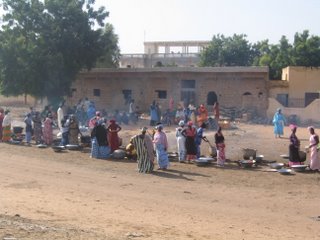
I wanted to include a few photos from the week of the funeral because I actually got a few with me in them and realize that they might be more interesting than bunches of Senegalese people that you don't know :) The funeral itself was solemn, but also really beautiful. The house filled with people from all over the country who came to pay their respects. I think that everyone in the family was quite honored.
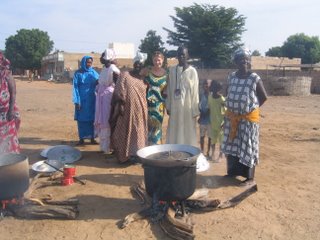
The women cooking in 18 big pots for all the guests.
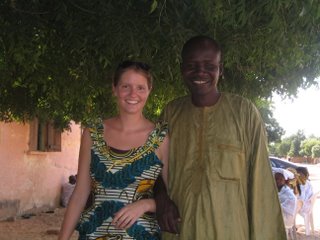
trying to help out, but mainly playing for the camera
Me and Pape
It's a Monday, and I can understand that... but even after a year, I can't help being annoyed when the person I am scheduled to meet with Monday at 9 am is still on an extended weekend in Dakar... and then the person I should meet at 11 has gone to the "allebi", the bush, which somehow takes on a black-hole/vacuum-esque quality whose absorbing force cannot be measured. "Do you know when he will be back?" Response "Eh, he went to the allebi" from this I am supposed to understand a timeframe...? So I resigned myself to whatever catch-up work I could get done in my office.
The office is quite a place. Like so many of us I think, I dread going to the office. But I maintain that my reasons are different. Every time I approach the building, an old colonial style that also houses the offices of the city Prefect, I have to playfully banter with the 6 idle adult males at the door. What makes my stomach turn is not how every morning I do the same act through gritted teeth "no, I can't be your wife, you are too ugly for me... no I can't take you to America... no, I still can't cook ceeb u diene" but actually the fact they are adult men who are getting paid just to sit around. They are somehow employees. Of what and for what is the great mystery. One might be a driver... there's another guy who sorts the mail (? In a country with 40% literacy and almost atrophied local government, let's be honest the Prefect does not get that much mail)... who knows what the other 4 guys do. But they are always there. In fact, after I tried to shut my door to my office today and in so doing shattered a lightbulb on my head, one of these men told me that he was the one that pulled the wiring out of the wall and let it hang there, putting the bulb in the way of the door. Hmmmmm.... Very effective....
The morning did turn around though-- I was preparing and translating lesson plans when I had my other mid-morning visitors. the guinea hens were back. Every day they roll in around 11:30... usually I just shoo them away and its not a big deal. What would possibly attract a pack of guinea hens to my cement and tile office anyway? And have you ever seen a guinea hen? I will try to get a photo, but they must be a Dr. Seuss creation-- an oversized oblong body set at a steep angle that looks almost like a football in a stand, and then a goofy little head that pokes up and around like an ostrich. Anyway, this particular morning caught me distracted and I ignored the hens pecking around on my floor for a few minutes. When I finally looked up again from my computer the ring leader had hopped onto the chair across the desk from me and sat there demanding answers. "Oh you too?" Until this very moment I am wondering how such an unwieldy body and useless wings got that hen all the way up onto the chair.
It seemed to coincide with the turmoil I have in my head. I can't get two thoughts together myself and this stupid half-ostrich is demanding answers? I'm caught in this endless debate about what to do after Peace Corps and I have no idea where to go. So here it is guys, this is the real chance to give me your opinions. What is a good field? Where can I make enough money to put an end to my rice and pounded leaf sauce diet? Do I need to go back to school? I was thinking med school but exploring options and who knows? Journalism? Public Policy? Could I really be a doctor? It's not all that far away...
I wanted to include a few photos from the week of the funeral because I actually got a few with me in them and realize that they might be more interesting than bunches of Senegalese people that you don't know :) The funeral itself was solemn, but also really beautiful. The house filled with people from all over the country who came to pay their respects. I think that everyone in the family was quite honored.

The women cooking in 18 big pots for all the guests.

trying to help out, but mainly playing for the camera

Me and Pape
It's a Monday, and I can understand that... but even after a year, I can't help being annoyed when the person I am scheduled to meet with Monday at 9 am is still on an extended weekend in Dakar... and then the person I should meet at 11 has gone to the "allebi", the bush, which somehow takes on a black-hole/vacuum-esque quality whose absorbing force cannot be measured. "Do you know when he will be back?" Response "Eh, he went to the allebi" from this I am supposed to understand a timeframe...? So I resigned myself to whatever catch-up work I could get done in my office.
The office is quite a place. Like so many of us I think, I dread going to the office. But I maintain that my reasons are different. Every time I approach the building, an old colonial style that also houses the offices of the city Prefect, I have to playfully banter with the 6 idle adult males at the door. What makes my stomach turn is not how every morning I do the same act through gritted teeth "no, I can't be your wife, you are too ugly for me... no I can't take you to America... no, I still can't cook ceeb u diene" but actually the fact they are adult men who are getting paid just to sit around. They are somehow employees. Of what and for what is the great mystery. One might be a driver... there's another guy who sorts the mail (? In a country with 40% literacy and almost atrophied local government, let's be honest the Prefect does not get that much mail)... who knows what the other 4 guys do. But they are always there. In fact, after I tried to shut my door to my office today and in so doing shattered a lightbulb on my head, one of these men told me that he was the one that pulled the wiring out of the wall and let it hang there, putting the bulb in the way of the door. Hmmmmm.... Very effective....
The morning did turn around though-- I was preparing and translating lesson plans when I had my other mid-morning visitors. the guinea hens were back. Every day they roll in around 11:30... usually I just shoo them away and its not a big deal. What would possibly attract a pack of guinea hens to my cement and tile office anyway? And have you ever seen a guinea hen? I will try to get a photo, but they must be a Dr. Seuss creation-- an oversized oblong body set at a steep angle that looks almost like a football in a stand, and then a goofy little head that pokes up and around like an ostrich. Anyway, this particular morning caught me distracted and I ignored the hens pecking around on my floor for a few minutes. When I finally looked up again from my computer the ring leader had hopped onto the chair across the desk from me and sat there demanding answers. "Oh you too?" Until this very moment I am wondering how such an unwieldy body and useless wings got that hen all the way up onto the chair.
It seemed to coincide with the turmoil I have in my head. I can't get two thoughts together myself and this stupid half-ostrich is demanding answers? I'm caught in this endless debate about what to do after Peace Corps and I have no idea where to go. So here it is guys, this is the real chance to give me your opinions. What is a good field? Where can I make enough money to put an end to my rice and pounded leaf sauce diet? Do I need to go back to school? I was thinking med school but exploring options and who knows? Journalism? Public Policy? Could I really be a doctor? It's not all that far away...
Tuesday, October 31, 2006
Who wins the prize?
This is certainly a twist on the development model...
Africa leaders offered prize for ruling well
By Alan Cowell The New York Times
Mo Ibrahim, a Sudanese-born billionaire, announced the creation of a $5 million prize for the sub-Saharan African president who demonstrates the greatest commitment to democracy and good governance during their time in office.
http://www.iht.com/articles/2006/10/26/news/prize.php
Africa leaders offered prize for ruling well
By Alan Cowell The New York Times
Mo Ibrahim, a Sudanese-born billionaire, announced the creation of a $5 million prize for the sub-Saharan African president who demonstrates the greatest commitment to democracy and good governance during their time in office.
http://www.iht.com/articles/2006/10/26/news/prize.php
Thursday, October 26, 2006
Must see/read news
Very exciting stuff from the world of microfinance. At least for me, I was giggling like a little girl...
Microlean Pioneer and His Bank Win Nobel Peace Prize
(this was a major inspiration to go into Peace Corps and Business Development)
and also
it's a must-see, great way to participate in one of the best grassroots development practices around.
Another great site for third-world development through entrepreneurship
All my best!
Meryl
Microlean Pioneer and His Bank Win Nobel Peace Prize
(this was a major inspiration to go into Peace Corps and Business Development)
and also
it's a must-see, great way to participate in one of the best grassroots development practices around.
Another great site for third-world development through entrepreneurship
All my best!
Meryl
Wednesday, October 25, 2006
laugh already!
Just to alternate from the bad news earlier in the week I have a couple funny stories to share…
First, I threw myself to the wolves today. There is always a kind of a power struggle here and age wins out, no matter what. In fact, the whole society is ordered this way. Good behavior is determined by the elders, people are accepted or rejected based on what the elder members of the community say, and it goes on and on. Every task is determined the same way, as a young person, you will be told how everything should be done—the laundry, the mopping, even how to cut an onion. This can be pretty annoying if you are university-educated foreigner who thinks she has a pretty good idea of how to cut an onion and doesn’t want to be pushed around. Worse yet is when the Wolofs around you decide after 30 seconds that you are physically incapable of cutting onions and refuse to let you try any more. But in the end, I decided to put myself to this test, knowing that if the gamble worked, the payoff would be enormous.
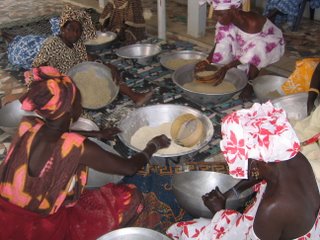
The test was “moyne” the act of mixing millet flour and water in a big calabash bowl to make tiny grains that will be made into couscous. Believe it or not, the process is pretty tricky and there is (of course) a specific technique to get the most perfect grains, not too dry, not too big, not too clumpy. It was awfully scary sitting in the middle of all the big-shot Wolof grandmothers and trying it, but I actually succeeded and the chorus of praise (WAAW Koumba! Waaw kaaye!) was definitely worth it. I knew that my acceptance was confirmed when I kept getting meat thrown in front of me at the bowl at lunch by an imposing grandmother with a very toothy smile.
The second story is courtesy of my neighbor Neil. The post here in Senegal is extremely expensive, but every once in a while we just have to mail something out. Neil wanted to mail a little music and a couple other things to a friend, but his package was going to cost him 8.000 cfa, which is just too much (about $16). The postman told him that if he could reduce the weight by 4 grams, the price would be cut in half. The two of them dissected the package, looking for something to throw out. Turning up nothing, the postman simply took the cd case, held the cover firmly, cracked it in half and threw out the piece not attached to the hinge. Problem solved.
First, I threw myself to the wolves today. There is always a kind of a power struggle here and age wins out, no matter what. In fact, the whole society is ordered this way. Good behavior is determined by the elders, people are accepted or rejected based on what the elder members of the community say, and it goes on and on. Every task is determined the same way, as a young person, you will be told how everything should be done—the laundry, the mopping, even how to cut an onion. This can be pretty annoying if you are university-educated foreigner who thinks she has a pretty good idea of how to cut an onion and doesn’t want to be pushed around. Worse yet is when the Wolofs around you decide after 30 seconds that you are physically incapable of cutting onions and refuse to let you try any more. But in the end, I decided to put myself to this test, knowing that if the gamble worked, the payoff would be enormous.

The test was “moyne” the act of mixing millet flour and water in a big calabash bowl to make tiny grains that will be made into couscous. Believe it or not, the process is pretty tricky and there is (of course) a specific technique to get the most perfect grains, not too dry, not too big, not too clumpy. It was awfully scary sitting in the middle of all the big-shot Wolof grandmothers and trying it, but I actually succeeded and the chorus of praise (WAAW Koumba! Waaw kaaye!) was definitely worth it. I knew that my acceptance was confirmed when I kept getting meat thrown in front of me at the bowl at lunch by an imposing grandmother with a very toothy smile.
The second story is courtesy of my neighbor Neil. The post here in Senegal is extremely expensive, but every once in a while we just have to mail something out. Neil wanted to mail a little music and a couple other things to a friend, but his package was going to cost him 8.000 cfa, which is just too much (about $16). The postman told him that if he could reduce the weight by 4 grams, the price would be cut in half. The two of them dissected the package, looking for something to throw out. Turning up nothing, the postman simply took the cd case, held the cover firmly, cracked it in half and threw out the piece not attached to the hinge. Problem solved.
Tuesday, October 24, 2006
siigil ndigale


The tragic news is that my host dad, Massar Sarr, passed away two days ago. I was just getting into a car to return to Louga from Dakar when I got the news on my cell phone. Baay Massar was in his 60s and has been ill and bed-ridden for several years, but the news was nevertheless a shock. There is a definite sadness that hangs over the house in recent days, but it is encouraging to see everyone regroup in the family and gather with the community. I have been able to spend more time with my family members than usual during this time, as well as learn much more about how they deal with the death of a family member. You can see a photo of the late Massar Sarr with his first wife and several of his grandkids or grand-nieces and nephews. The other photo is Massar's brother with two visitors.
I learned a Wolof proverb today: Boo xeye gis say mbokki yepp, amulo lii la geunal. A rough translation is : He who awakens in the morning and sees all of his relatives knows that bad news awaits. the significance is that in Senegal a family member might miss a big holiday or occasionally a baptism but no one would miss a funeral. And it seems to be true. The house has been full of people over the past few days and I have met so many relatives that I never have seen before.
The funeral ceremony is planned for Sunday. From what I can gather, there will be a part where men sing verses of the Koran for several hours in front of the house, and the local marabout will spend the day along with all the relatives and neighbors at the house. Up until then, the three remaining wives of my host dad lay in a room wearing white head scarves and surrounded by blankets made in the traditional weaving style of Senegal. Community members and friends come to the doorway of the room and kneel, offer their condolences and then drop coins or small bills into a basket in front of the women.
Even though each person only spends a few moments with the women, they stay outside and spend the day sitting and talking. I had an interesting conversation with a couple of the neighborhood men. One of them posed the question, “if you had lots and lots of money, what would you do?”
I spit out my very predictable answer “travel”
The other two men responded “build a mosque” and then “build a house for my family, build a franco-arab school and then build a mosque”
Chew on that one for a little while.
Thursday, October 12, 2006
Ode to Underwear
We are roughly 20 days into Ramadan right now which means its pretty slow around here. You've probably noticed that I haven't written since then. I've actually been more busy with work recently since everything comes down during Ramadan and we can get more real work done.
I just got out of the shower and consequently, done washing my underwear by hand. I have to comment on the monotony and ridiculousness of this task. I can't set out underwear with the rest of my clothes to be washed-- we were told it was culturally insensitive. I never got the whole gist of it, but I'd hate to be stepping on toes. So every day I wash my underwear. I don't think I would want to set it out anyway seeing as how my clothes always come back as though they've seen the third world war. Bleach and mysterious hole-creating forces permeate my clothes, despite the hardest work of the girl who regularly does my laundry. So everything is literallly torn apart and even though I wash my own underwear I am starting to see holes take over. The laundry soap here I am convinced smells worse that actual dirty clothes smell and doesn't succeed in actually removing much dirt. Maybe it is my half-hearted sloshing around of soap and underwear in the water bucket, but every time I take my sun-stiffened underwear off the line I find myself cringing at the thought of having to put these on again in a few days. The real test comes when you have been a volunteer long enough to be willing to buy your underwear from the local goodwill-style clothes seller. I've wandered into that part of the market, been drawn to it (such is the allure of non-sun-stiffened undergarments) but I still haven't made the jump. This is perhaps my ultimate weakness as a volunteer. Bring on the plague of crickets (I count 6 on my computer screen right now). Bring on dysentery and giardia. bring on sheep intestines and fish heads. But something restrains me from making that last break from Toubab-ness, buying underwear of unknown origins. So this leads me now to the Ode to Mom, who has agreed to mail me new, never before hand-washed underwear.
In other news, our bull broke out of his pen today and wreaked havoc in the house. ever heard of the bull in the China shop? This is what happens when you keep the cows in the house.
And, tomorrow I will attempt to fast with the Senegalese. Wish me luck!
Miss you all!
I just got out of the shower and consequently, done washing my underwear by hand. I have to comment on the monotony and ridiculousness of this task. I can't set out underwear with the rest of my clothes to be washed-- we were told it was culturally insensitive. I never got the whole gist of it, but I'd hate to be stepping on toes. So every day I wash my underwear. I don't think I would want to set it out anyway seeing as how my clothes always come back as though they've seen the third world war. Bleach and mysterious hole-creating forces permeate my clothes, despite the hardest work of the girl who regularly does my laundry. So everything is literallly torn apart and even though I wash my own underwear I am starting to see holes take over. The laundry soap here I am convinced smells worse that actual dirty clothes smell and doesn't succeed in actually removing much dirt. Maybe it is my half-hearted sloshing around of soap and underwear in the water bucket, but every time I take my sun-stiffened underwear off the line I find myself cringing at the thought of having to put these on again in a few days. The real test comes when you have been a volunteer long enough to be willing to buy your underwear from the local goodwill-style clothes seller. I've wandered into that part of the market, been drawn to it (such is the allure of non-sun-stiffened undergarments) but I still haven't made the jump. This is perhaps my ultimate weakness as a volunteer. Bring on the plague of crickets (I count 6 on my computer screen right now). Bring on dysentery and giardia. bring on sheep intestines and fish heads. But something restrains me from making that last break from Toubab-ness, buying underwear of unknown origins. So this leads me now to the Ode to Mom, who has agreed to mail me new, never before hand-washed underwear.
In other news, our bull broke out of his pen today and wreaked havoc in the house. ever heard of the bull in the China shop? This is what happens when you keep the cows in the house.
And, tomorrow I will attempt to fast with the Senegalese. Wish me luck!
Miss you all!
Sunday, October 08, 2006
Development in Gardening
Check out a fantastic initiative started by some of our very own Senegal volunteers. A n NGO dedicated to caring for AIDS patients with self-sustaining gardening projects.
http://www.developmentingardening.org/DIG/HOME.html
http://www.developmentingardening.org/DIG/HOME.html
Monday, September 18, 2006
School (again) and wildlife stories
Absolutely crazy morning. I guess I was feeling sleepy anyway and should be happy for this turn of events, but still it is disappointing. I showed up to my computer class with the people from my house this morning at 10 only to find that the government did not pay the electricity, phone or water bills for any school in the country. So all the services have been cut off. Thank goodness regular classes have not yet begun, but for any extra things like summer study sessions, watering the plants and trees as well as computer classes like mine, things are difficult.
Just makes you appreciate a public school system that functions.
In other news, I should talk about my recent craziness. Normally I would hide this from the blog and pretend that I am only a stellar volunteer, but the truth is I’ve gone a bit crazy, and certain associates have encouraged me to share it with you as evidence of what service in the third world can do to a person.
I’ve had some recent brushes with the wilderness that remind me just how far I am from being comfortable on a couch in suburban Indiana.
I went running with my neighbor Neil the other day where we normally run, way out in the bush where there are fewer people and cars and the air is (usually) fresher. Only about 400 meters into the run, right in the middle of farmer’s fields which are almost ready for harvest, we see an enormous truck emptying none other than tanks full of sewage and human waste onto the ground. Needless to say, the smell was terrible and neil and I kind of freaked out about the health implications—just the other day I sat around with my whole family eating beans practically fresh off the vine. Really scary thoughts.
It gets better (or worse). The rains have really dredged up a lot of insects, meaning that I chase roaches and geckos and crickets out of my room nightly. I guess I didn’t do so well a few nights ago because I woke up feeling really congested—I thought I might be getting sick until I blew my nose and found, guess what, a spider. Miracles of the human body—at least this means that I didn’t ingest it.
Which is better than I can say for the fish eyes the following evening for dinner. (and I forgot to tell you that my last meal before leaving for the states happened to be sheep’s head. Normally when we eat sheep’s head I don’t even know it because all the meat has been pulled off the bones ahead of time. But this time, for some reason, the cook left all the parts in, including jaw bones filled with teeth. My one mom even took the jaw, cracked it in half and pulled the tongue out from inside and tried to feed it to my cat. Scary when even the cat won’t look at it twice.)
One more wildlife story-- we have our cows tied up outside the house these days (there is one that just had a baby which is sooo cute!) While I was walking to the boutique on the corner my first mom started yelling at everyone to grab the baby cow. He was eating a big plastic bag—so we all kind of danced around trying to get the bag out of his mouth, but he took refuge under his mom and then the mom started charging at people. She was tied to a tree, so we all got out in the end, but it would have been terrible to be gored by a cow’s horn in front of my very own house. And the silly baby cow ate the whole plastic bag and choked and coughed for a while.
Just makes you appreciate a public school system that functions.
In other news, I should talk about my recent craziness. Normally I would hide this from the blog and pretend that I am only a stellar volunteer, but the truth is I’ve gone a bit crazy, and certain associates have encouraged me to share it with you as evidence of what service in the third world can do to a person.
I’ve had some recent brushes with the wilderness that remind me just how far I am from being comfortable on a couch in suburban Indiana.
I went running with my neighbor Neil the other day where we normally run, way out in the bush where there are fewer people and cars and the air is (usually) fresher. Only about 400 meters into the run, right in the middle of farmer’s fields which are almost ready for harvest, we see an enormous truck emptying none other than tanks full of sewage and human waste onto the ground. Needless to say, the smell was terrible and neil and I kind of freaked out about the health implications—just the other day I sat around with my whole family eating beans practically fresh off the vine. Really scary thoughts.
It gets better (or worse). The rains have really dredged up a lot of insects, meaning that I chase roaches and geckos and crickets out of my room nightly. I guess I didn’t do so well a few nights ago because I woke up feeling really congested—I thought I might be getting sick until I blew my nose and found, guess what, a spider. Miracles of the human body—at least this means that I didn’t ingest it.
Which is better than I can say for the fish eyes the following evening for dinner. (and I forgot to tell you that my last meal before leaving for the states happened to be sheep’s head. Normally when we eat sheep’s head I don’t even know it because all the meat has been pulled off the bones ahead of time. But this time, for some reason, the cook left all the parts in, including jaw bones filled with teeth. My one mom even took the jaw, cracked it in half and pulled the tongue out from inside and tried to feed it to my cat. Scary when even the cat won’t look at it twice.)
One more wildlife story-- we have our cows tied up outside the house these days (there is one that just had a baby which is sooo cute!) While I was walking to the boutique on the corner my first mom started yelling at everyone to grab the baby cow. He was eating a big plastic bag—so we all kind of danced around trying to get the bag out of his mouth, but he took refuge under his mom and then the mom started charging at people. She was tied to a tree, so we all got out in the end, but it would have been terrible to be gored by a cow’s horn in front of my very own house. And the silly baby cow ate the whole plastic bag and choked and coughed for a while.
Subscribe to:
Posts (Atom)